
Mineela Chand has spent more than 25 years working at the intersection of human behavior and leadership development.
Today, she brings that experience together through Cognitive Performance Engineering, helping high-performing business owners and leaders understand how they work, make clearer decisions, and follow through more consistently.
Her approach draws from leadership consulting, organizational development, and corporate change to identify what is working, where unnecessary effort is creating strain, and what may need to be supported, simplified, delegated, or redesigned.
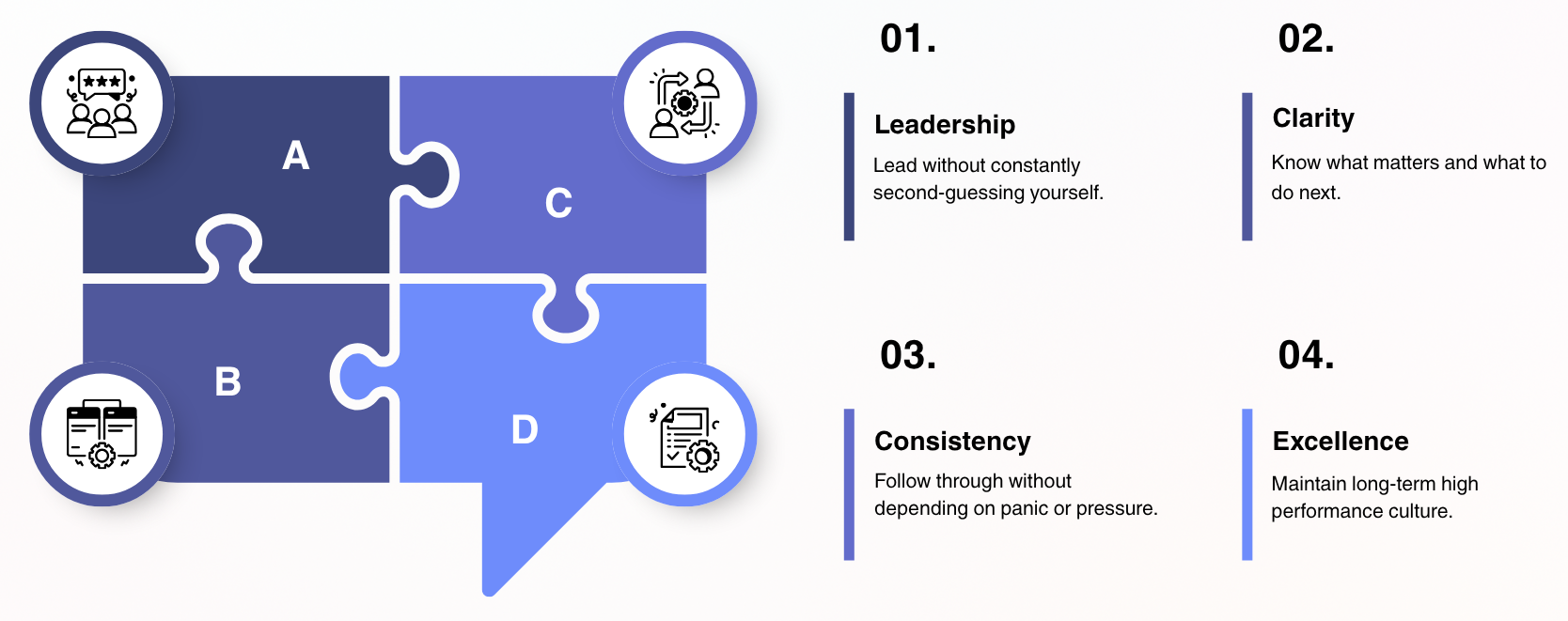
Her work is built around three priorities:
- Leadership: Lead with greater self-awareness and intention.
- Clarity: Understand the patterns behind your decisions, focus, and follow-through.
- Consistency: Build ways of working that do not depend on pressure, urgency, or burnout.
The Executive Function Index is often the best place to begin. It gives you a personalized map of your strengths, supported areas, and highest-friction points, so you can stop guessing and focus on the changes most likely to help.



“Knowing what to do is not always the same as being able to access what you know. Understanding that difference can change how you work, lead, and see yourself.” – Mineela Chand, LMFT, M.Div.
25+ Years
Clinical and leadership experience
12 functions
Mapped into a clear personal profile
Human-centered
Evidence-based and practical
More about Mineela’s EFI-Based Approach
You don’t need to become a different kind of leader.
You need to understand how your mind works, what helps you perform well, and what is quietly making leadership harder than it needs to be.
I help high-performing business owners and leaders build greater clarity, stronger follow-through, and a more sustainable way to lead.
My work combines more than 25 years of experience in human behavior with a background in leadership consulting, organizational development, and corporate change.
That means I do not look at executive function in isolation.
I look at how it affects your decisions, communication, workload, relationships, energy, and ability to lead when the pressure is real.
Our work together is evidence-based, practical, and built around you.
Leadership Starts With Understanding Yourself
You can be intelligent, experienced, and highly capable while still struggling with the invisible mechanics of leadership.
You may know what needs to happen but have trouble beginning.
You may make strong decisions, then lose track of the follow-through.
You may solve complicated problems while avoiding routine tasks that seem like they should be easy.
You may even appear calm and capable while privately relying on urgency, overwork, or sheer determination to keep everything moving.
That does not mean you are failing as a leader.
It may mean your current way of working asks too much from executive functions that need better support.
My Work Is Built Around Three Things
1) Leadership
Leading with greater self-awareness.
Leadership is not only about vision, confidence, or strategy.
It also depends on your ability to regulate under pressure, make decisions, communicate clearly, manage competing demands, and follow through on what you said you would do.
When you understand the patterns beneath your leadership, you can respond more intentionally instead of always reacting to what feels most urgent.
You can protect your strengths, communicate your needs, and build support around the areas that create the most friction.
2) Clarity
Understanding what is actually happening.
Many of the people I work with have spent years asking:
Why is this so hard when I know what to do?
They have tried planners, productivity systems, routines, apps, accountability, and better time management.
Some tools helped temporarily. Others became one more thing to maintain.
Clarity begins when you stop treating every struggle as the same problem.
Difficulty following through may involve attention, working memory, task initiation, emotional load, time awareness, or several functions interacting at once.
When you understand the real pattern, you can stop guessing and make more useful decisions.
3) Consistency
Building a way of working you can sustain.
Consistency does not mean performing perfectly every day.
It means creating enough support that your work does not depend entirely on motivation, urgency, memory, or your ability to push through exhaustion.
Together, we look at the systems, environments, expectations, and habits shaping how you work.
Then we make practical changes that fit your mind, your responsibilities, and the conditions you are actually leading within.
This is how it looks when everything is working together:
Why My Approach Is Different
I began my career in leadership consulting and organizational development.
Early in my career, I watched talented leaders struggle with patterns no one around them knew how to explain.
The usual leadership advice focused on strategy, motivation, or discipline. It rarely accounted for the invisible effort required to make decisions, manage competing demands, regulate under pressure, and keep everything moving.
That led me to study human behavior more deeply.
Over the next 25 years, I worked with people navigating complex patterns involving attention, stress, emotion, decision-making, communication, and follow-through.
But I never left the organizational world behind.
Through Employee Assistance Programs and corporate work, I supported people inside the real conditions affecting their performance: restructures, new leadership, team conflict, changing expectations, deadlines, power dynamics, and the pressure to keep functioning when the ground beneath them was shifting.
As a result, I understand how people function.
I also understand what happens when those patterns collide with payroll, clients, teams, quarterly goals, family responsibilities, and the consequences of getting it wrong.
That combination shapes everything I do.
I DoN’t Believe More Is Always Better
I trained in solution-focused brief therapy and targeted intervention because I believe the right change matters more than the volume of advice.
The fact is, you don’t need another 47-step system.
You need to know which few changes are likely to create the greatest relief.
My work is practical, focused, and designed to fit real life.
- We identify the point of friction.
- We understand what is driving it.
- Then we build support around it.
Start With the Executive Function Index
Stop guessing why some things feel harder than they should.
The Executive Function Index (EFI) is a personalized report that helps you understand how your executive functions are operating right now.
It looks at 12 areas involved in how you:
- Begin tasks
- Stay focused
- Plan and prioritize
- Manage time
- Hold information in mind
- Regulate emotions
- Shift when circumstances change
- Pause before acting
- Solve problems
- Follow through
Your results are organized into three areas:
- Strength. These are Functions that currently support you well.
- Adaptive. Areas you manage through effort, tools, structure, or compensation.
- Challenge. Areas creating repeated friction, inconsistency, or unnecessary strain.
This is not a personality test, a diagnosis, or a pass-fail score.
It is a practical map of how you currently operate, based on your own experience.
Your report helps you see:
- What is already working
- What may be costing more energy than anyone realizes
- Where better support could make the greatest difference
- Which areas deserve your attention first
Ready to understand your mind?
What Happens After the EFI?
Your EFI shows you the pattern.
The next step is deciding what to do with it.
For some people, the report provides enough insight to begin making changes independently.
Others want support translating the results into their business, leadership, communication, delegation, workload, and daily systems.
That is where the Leadership Executive Function Index (LEFI) comes in.
Leadership executive function index (LEFI)
LEFI is my personalized Cognitive Performance Engineering program for business owners and leaders who want to apply what they learn through the EFI to the way they actually work and lead.
Together, we examine what to:
- Protect
- Simplify
- Delegate
- Externalize
- Redesign
- Stop carrying alone
The goal is not to turn you into a different person.
It is to help you lead with greater clarity, consistency, and less internal friction.
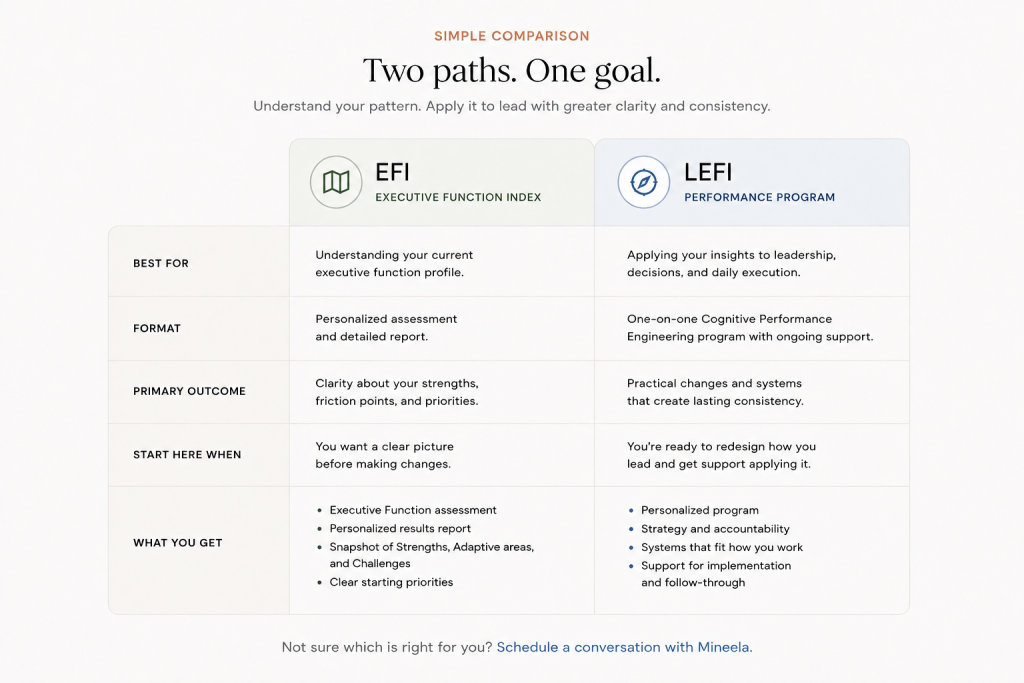
Here’s a quick comparison of EFI and LEFI:
What I Bring to the Work
Depth of experience
More than 25 years helping people understand the patterns affecting attention, emotion, decision-making, and executive function.
Organizational experience
A background in leadership consulting, team development, corporate change, and Employee Assistance Programs.
Practical intervention
Clear language, focused support, and changes designed for implementation, not theory.
Respect for context
Your challenges do not exist outside your workload, identity, relationships, health, responsibilities, and the systems you operate within.
A human-centered approach
We do not force change through shame, pressure, or the assumption that you simply need more discipline.patterns that affect executive function.
Organizational experience
A background in leadership consulting, team development, corporate change, and Employee Assistance Programs.
Practical intervention
Clear language, targeted support, and changes designed for implementation, not theory.
Respect for context
Your challenges do not exist outside your workload, identity, relationships, health, responsibilities, and the systems you operate within.
A human-centered lens
We do not force change through shame, pressure, or the assumption that you simply need more discipline.
Why I Do This
Because productivity advice means very little when it ignores executive function, pressure, context, and the realities of leadership.
Because “try harder” isn’t a strategy.
Because knowing what to do is not always the same as being able to access what you know.
And because once you understand how your mind works, you can stop building around an imaginary version of yourself.
You can build around the person who is actually here.
Beyond the Work
I host ADHD Running in Heels, a podcast exploring leadership, work, identity, and what it takes to build a life that works with your mind rather than against it.
I am also an avid seamstress, voracious reader, science-fiction and fantasy fan, and lifelong student of spirituality, culture, and the ways identity shapes our experience.
I bring both associative thinking and close attention to detail into my work, which is fitting for a practice built around helping people understand complicated patterns and turn them into practical change.
Ready to Understand What Is Getting in the Way?
You already know you’re capable.
The EFI helps you understand what is supporting that capability, what it may be costing you, and where the right changes could create more ease.
